

Nearly one in five U.S. investors say they have considered direct, person-to-person crypto deals—an eye‑opening sign that peer-to-peer activity is no longer niche.
This buyer’s introduction explains what a U.S. reader should know before placing a first trade. It defines the page’s purpose: a practical buyer’s guide for evaluating peer-to-peer platforms and planning a first transaction responsibly.
P2P platforms usually act as facilitators: they provide escrow, dispute tools, and user ratings rather than becoming the counterparty. Expect flexible pricing and multiple payment rails—but also counterparty risk and the need for disciplined steps like proof of payment and escrow use.
The article will cover definitions and growth drivers, comparisons with centralized venues, a step-by-step transaction flow, benefits and risks, platform selection, pricing and spreads, security and privacy, first‑trade workflow, and scaling tools. Readers are reminded this is educational information only—not financial advice—and to check local rules and platform terms.
Practical outcome: by the end, a reader should be able to compare platforms, estimate true costs, and reduce common fraud and payment disputes using a simple safety checklist and best practices like those in this peer-to-peer platform note.
Key Takeaways
- This section frames the piece as a buyer’s guide for U.S. users considering their first P2P transaction.
- P2P platforms provide escrow and dispute resolution, not counterparty liquidity.
- Expect flexible payments and pricing—also higher counterparty risk without discipline.
- “Market entry” here means choosing a platform, payment rails, pricing, and a safety checklist.
- This is educational content only; verify local regulations and platform rules before acting.
What crypto P2P trading is and why it’s growing in the United States
Peer-to-peer trading lets individuals agree on a price and payment method, then settle directly instead of going through an exchange order book. This model puts buyers and sellers in charge of terms, timing, and payment rails while a platform connects them and holds assets in escrow during the swap.

U.S. interest has grown for clear reasons: broader familiarity with cryptocurrency, rising stablecoin use, and demand for flexible payment options that some centralized venues do not offer. More users want local payment methods and control over deal terms.
- What platforms do: provide listings, reputation signals, escrow, and dispute channels.
- What platforms don’t do: they usually are not the payer or payee, cannot force bank timing, and cannot remove all counterparty risk.
- Reputation matters: ratings, reviews, and trade counts help users choose trusted counterparties.
Expect varying verification rules in the U.S.: many platforms require KYC depending on volume and local law. For a practical primer on how these systems work in real trades, see this beginner’s overview.
P2P trading vs centralized exchanges for buying and selling cryptocurrency
When choosing between a centralized exchange and a negotiated marketplace, understanding execution mechanics helps buyers pick the right venue.
How centralized exchanges work:
- Orders route through an order book; matching is automated and fast.
- High liquidity and speed reduce execution time, but fills can suffer from slippage when depth is thin.
- “Price drift” occurs when rapid order book moves cause an execution at a different price than expected.
How negotiated marketplaces differ:
- Offers and ads set terms—buyers and sellers negotiate price and payment method directly.
- Traders gain more control over prices, limits, and counterparties, and can choose specific rails for settlement.
- More control brings responsibility: verify payments, collect proof, and follow the platform’s escrow rules.
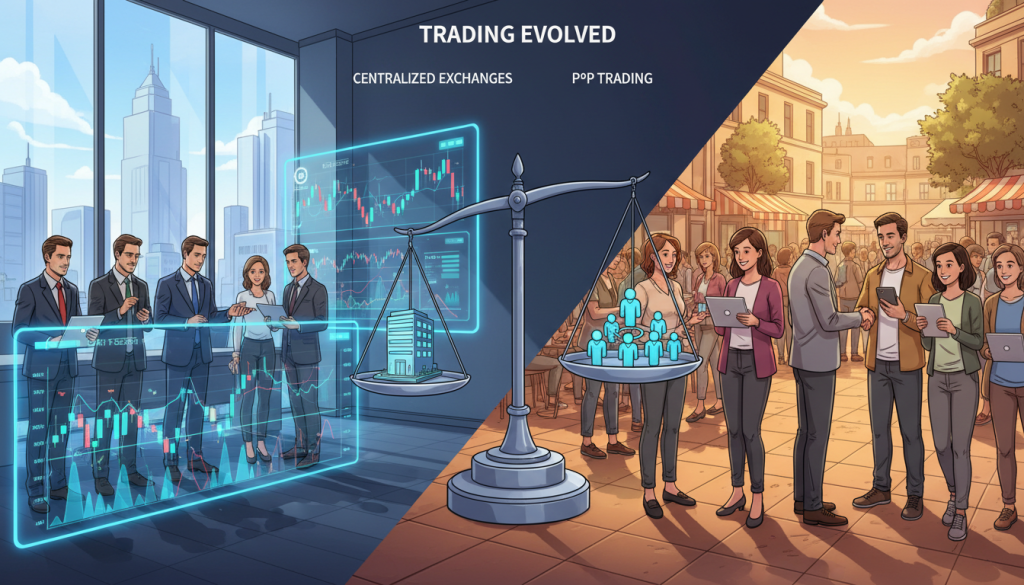
| Feature | Centralized exchange | Negotiated marketplace |
|---|---|---|
| Execution | Order book, automated | Manual, negotiated |
| Best for | Speed and deep liquidity | Payment flexibility and chosen counterparties |
| Risk tradeoff | Slippage/price drift | Counterparty and payment risk |
Decision lens for U.S. buyers: choose an exchange for fast fills and deep liquidity. Choose a negotiated marketplace when payment rails or bespoke terms matter more than raw speed.
How a P2P crypto transaction works from start to finish
A typical transaction follows a clear sequence: register, verify, browse offers, start a trade, crypto is placed into escrow, payment is made, and the asset is released once payment is confirmed.
Account creation and verification
Create an account and enable baseline security: email confirmation and two-factor authentication. Platforms request verification to reduce fraud, meet regulatory expectations, and raise transaction limits.
Browsing offers
Filter listings by advertised rate, minimum/maximum limits, supported payment method, and counterparty reputation. Read seller notes and recent feedback to judge reliability.
Escrow and release rules
When a trade begins, the seller’s asset is locked in escrow so it cannot be moved. Sellers must follow the “do not release early” rule: release only after confirming cleared funds in their own account.
Payment confirmation and disputes
“Received” differs by method—bank transfers are settled when posted, mobile wallet transfers when credited, and cash when deposited. Keep timestamps, receipts, bank reference numbers, and full in-platform chat logs.
- Keep all communication on the platform to preserve evidence.
- Do not accept off-platform confirmations such as screenshots without a settled payment.
- If a dispute arises, provide receipts, timestamps, payer details, and chat history to support resolution.
| Step | What to confirm | Typical time |
|---|---|---|
| Initiate trade | Offer terms, limits, payment method | Minutes |
| Payment & confirmation | Settled funds or posted transfer | Minutes to days |
| Release from escrow | Seller confirms cleared payment | Immediate after confirmation |
Core benefits that make P2P crypto trading attractive
Peer-to-peer platforms deliver distinct advantages—especially around fees, payment rails, and discretion. These venues often appeal to users seeking alternatives to large exchanges.
Lower or no platform fees
Many P2P venues charge little or no direct trading fee, which can make small trades more economical. Users still face bank transfer costs and network fees for digital assets, so add those into total cost calculations.
Flexible pricing and deal terms
Ads may use fixed prices or formula-based spreads. That lets buyers and sellers react when markets move quickly and set limits, response windows, and acceptable payment references.
More privacy and broader access
P2P can offer greater discretion and more local payment options. U.S.-facing platforms may still request ID—so privacy here means choice and reduced reliance on a centralized counterparty, not anonymity.
| Benefit | How it helps | Consideration |
|---|---|---|
| Low fees | Lower transaction costs | Bank and network charges still apply |
| Flexible method | Custom payment arrangements | Requires clear proof and rules |
| Local access | Use familiar rails for settlement | May limit liquidity on some offers |
Risks and trade-offs to understand before your first P2P trade
Before you make a first peer-to-peer swap, understand the concrete risks that come from dealing directly with other people. This section outlines common pitfalls and how to reduce exposure.
Scams and fraud patterns
P2P is counterparty-based: the risk often lies with the individual, not the platform brand. Social engineering and pressure to move off-platform are common tactics.
Sellers may claim a payment was sent or show fake receipts. Always insist on cleared funds and keep chat on the platform.
Payment disputes and delays
Disputes arise from name mismatches, delayed bank credits, partial transfers, or chargeback-like reversals. These events can lock funds or extend completion time.
Liquidity and time constraints
Smaller venues can have fewer active offers. That widens spreads, lengthens completion time, and raises exposure to market moves during a transaction.
Volatility during the window
Price can swing between initiation and confirmation. This matters most in fast markets and for larger amounts.
- Mitigations: start small, prefer high-reputation counterparties, follow escrow rules, and document all proof of payment.
- Remember: these steps reduce risk but do not remove it entirely.
| Risk | Common cause | Typical outcome |
|---|---|---|
| Fraud | Social engineering; off-platform pressure | Lost funds; disputed release |
| Payment dispute | Delayed or reversed bank transfer | Trade delay; escrow hold |
| Low liquidity | Few active offers on small platform | Wider spreads; longer time to complete |
| Volatility | Price movement during confirmation | Unfavorable execution for buyer or seller |
crypto p2p trading market entry guide: choosing the right P2P platform
Platform choice shapes safety, cost, and speed for first-time users. A disciplined checklist helps separate reputable venues from casual listings.
Escrow protection and dispute processes as non-negotiables
Escrow must lock assets automatically once a trade begins and show clear status updates. Good escrow systems include timeouts, explicit release rules, and an audit trail of chat and receipts.
Expect a published dispute policy with defined response windows and a list of required evidence. Platforms should handle ambiguous cases—such as pending transfers—by pausing release until proof is verified.
Reputation signals: ratings, reviews, and trade history
Prefer traders with consistent ratings and meaningful trade counts. Look for recent feedback that references timely releases and accurate pricing.
A profile with many small, completed trades often offers better real-world reliability than one with few large trades.
Supported cryptocurrencies and trading pairs
Major assets matter: BTC, ETH, and USDT often provide tighter spreads and faster exits. Verify which cryptocurrencies a platform supports before depositing funds.
Payment rails offered for U.S. users
Check available payment methods—ACH, wire, and popular mobile wallets vary by platform and can affect timing and reversibility. Confirm limits and any restrictions before choosing an offer.
- Platform checklist: escrow + dispute handling, visible reputation, asset coverage, and U.S. payment rails.
- Good escrow: automatic lock, clear release rules, auditable communications.
- Disputes: published timelines, evidence checklist, and escalation paths.
| Criteria | What to expect | Why it matters |
|---|---|---|
| Escrow rules | Auto-lock, timeouts, release only after cleared payment | Prevents premature release and fraud |
| Dispute process | Response window (24–72 hrs), evidence list, neutral arbiter | Speeds resolution and protects users |
| Reputation | Ratings, recent feedback, trade volume | Signal reliability and behaviour patterns |
| Asset coverage | BTC, ETH, USDT commonly supported | Improves liquidity, lowers spreads, eases exits |
| U.S. payment rails | ACH, wire, mobile wallets, bank limits | Affects settlement time and reversal risk |
For a compact primer on how these platforms function, see this what is crypto P2P trading.
Payment methods on P2P exchanges and how to pick the safest option
Different payment methods bring widely different proofs, reversal risks, and completion times. Choosing wisely reduces dispute risk and speeds a transaction.
Bank transfers: timing and caution
Bank transfers often provide the strongest audit trail—bank reference numbers and posted credits that many platforms accept as solid proof.
Timing varies: some banks post same-day, others next-day after cutoffs. Treat “pending” notices cautiously and wait for cleared funds before release.
Mobile wallets and local rails
Mobile wallets are convenient and fast. Finality depends on the provider—some transfers can be reversed or disputed.
Users should confirm whether a wallet payment is irrevocable and keep app receipts and transaction IDs for disputes.
Cash deposits: extra caution required
Cash deposits carry higher fraud risk and weaker audit trails. Proof often relies on ATM or teller receipts, which vary in quality.
Beginners should avoid large cash deals and prefer methods with bank-issued confirmation.
- Risk categories: reversible vs less reversible; strong vs weak proof.
- Align payer identity details and save receipts, screenshots, and chat logs.
- For a concise primer on safe payment options, see this payment options primer.
| Method | Proof quality | Reversal risk | Typical timing |
|---|---|---|---|
| Bank transfer | High (bank ref, statement) | Low after clearing | Same-day to next-day |
| Mobile wallet | Medium (app ID, TXID) | Medium (depends on provider) | Minutes to hours |
| Cash deposit | Low (receipt variability) | High (fraud/prank deposits) | Immediate, but verification slow |
Understanding P2P pricing, spreads, and total trade costs
Prices on negotiated platforms often differ from spot quotes because counterparties add premiums for settlement speed, reversibility risk, and convenience. Buyers and sellers bake these factors into the listed price.
Why listed price can diverge from spot
Counterparties consider liquidity, how fast funds clear, and the chance a payment is reversed. Those elements increase the effective price for the buyer or reduce it for the seller.
How spreads and adjustable pricing work
Spreads here are more than bid/ask differences. They include a convenience premium for fast rails or trusted sellers. Ads may track spot with a markup or discount that changes during volatility.
Hidden costs to watch
- Platform and network fees: platform commissions, blockchain gas, and withdrawal costs.
- Bank and wallet fees: wire or ACH charges, and mobile wallet transfer fees.
- Chargeback risk: reversible payments raise spreads and stricter terms.
Compare effective rates by estimating net received or net paid after all fees and risks. Focus on the final funds movement, not just the headline price, to make better decisions in crypto trading and related transactions.
Security checklist for safer peer-to-peer cryptocurrency trading
Start every deal by confirming the counterparty’s track record and recent activity on the platform. A brief vet reduces risk and speeds resolution if issues arise.
How to vet a seller or buyer before initiating transactions
Check ratings, completed trade count, and account age. Note typical response time and whether terms are consistent across listings.
- Verify reputation with recent feedback and trade volume.
- Confirm payment methods match the ad and match platform rules.
- Prefer counterparties with a clear history of timely releases.
Why off-platform deals are dangerous
Avoid moving communications or payments off-platform. Escrow protections and dispute resolution usually apply only inside platforms.
Off-platform deals remove audit trails and void formal recourse if a seller or buyer changes terms.
Two-factor authentication and account protection basics
Enable 2FA, use strong unique passwords, and review active sessions. Lock account recovery options to an email or phone you control.
Keeping crypto in a personal wallet vs leaving assets on platforms
For active swapping, platform wallets offer convenience. For storage beyond short-term needs, consider a personal wallet to reduce custodian exposure to platform risk.
| Control | When to use | Risk |
|---|---|---|
| Platform wallet | Frequent trades | Custodial risk |
| Personal wallet | Long-term holding | User-responsibility for keys |
| Escrow | Single trades | Depends on platform dispute process |
Privacy matters: keep communication in-platform and share only necessary details. Save receipts, timestamps, and chat logs—documentation often decides dispute outcomes.
For more safety tips before a first purchase, review these tips for buying crypto safely.
Speed, settlement time, and liquidity: what to expect in real trades
A quick transaction often comes down to prompt replies and a predictable settlement rail. In negotiated venues, human response and payment finality set the clock more than automatic matching.
Why p2p can be fast when both parties respond quickly
When buyer and seller act promptly, a clear path appears: pay, confirm, and release from escrow. This “fast path” can complete in minutes with reliable rails and active traders.
What causes delays and how to reduce them
Delays stem from slow payments, bank cutoffs, weekends, unclear references, or slow replies. Disputes about proof of transfer also slow completion.
- Set realistic expectations: speed varies with human response and settlement time.
- Pick reliable methods: choose payment rails with predictable clearing.
- Trade when active: use high-activity merchants and daytime hours for faster matching.
| Factor | How it affects time | Practical tip |
|---|---|---|
| Liquidity | More ads speed matching | Prefer platforms with many active traders |
| Payment rail | Bank holds vs instant wallets | Use rails with clear finality |
| Counterparty response | Slow replies extend completion | Choose sellers with fast response scores |
| Platform rules | Escrow and dispute windows add time | Follow evidence checklist to avoid disputes |
Note: centralized exchange execution may be quicker on the matching side, but fiat settlement still depends on the same rails and can delay transactions.
Privacy, control, and verification in modern P2P trading
Modern peer-to-peer platforms shift duties from a central provider to the people in a trade. That change affects how privacy and control work day to day.
How P2P can reduce reliance on centralized intermediaries
P2P models let buyers and sellers set price and settle directly, which reduces dependence on centralized exchanges for execution.
The platform still provides coordination tools—escrow, chat logs, and dispute workflows—that keep trades orderly.
When verification or KYC may still come into play
Verification appears for clear reasons: fraud prevention, regulatory compliance, higher limits, and better dispute handling.
Users should expect tiers: basic access may need minimal information, while larger limits or disputed trades often trigger full verification.
- Review what personal information a platform collects and why.
- Check how that information is stored and what triggers extra verification.
- Assume some platforms will require ID in the U.S., even if marketing claims “no KYC.”
| Benefit | Practical note | When verification applies |
|---|---|---|
| More control | Choose counterparties and payment rails | Default |
| Greater discretion | Selective visibility to counterparties | Limited without KYC |
| Platform protections | Escrow and dispute evidence | Enhanced after verification |
Control brings responsibility: keep confirmations, retain clear information for disputes, and use strong account security. These steps protect funds when working outside large custodial systems for cryptocurrency and related swaps.
Your first P2P trade: a practical getting-started workflow
Start with a simple checklist to move from registration to a completed swap without avoidable mistakes.
Setting up your account and securing access
Create an account and enable two-factor authentication immediately. Confirm notification settings so the platform alerts you to messages and status changes.
Understand verification steps that affect limits and dispute handling before funding any balances.
Choosing an offer by price, payment method, and reputation
Compare the seller’s price to spot and explainable premiums. Confirm the listed payment method and any required transfer notes.
Prioritize counterparties with recent, high-volume feedback and clear written instructions in their ads.
Completing payment and confirming receipt correctly
When a trade starts, the seller’s asset goes into escrow. Follow the seller’s instructions exactly—but only as allowed on the platform.
Buyers should not mark “paid” until a traceable payment is sent. Keep bank or wallet receipts, timestamps, and reference numbers.
Releasing crypto from escrow and documenting the transaction
Sellers must verify cleared funds before releasing the escrowed crypto. Release completes the crypto leg of the transaction.
Save screenshots, chat logs, and receipts for taxes, records, or disputes. Start small with mainstream assets like BTC or USDT and simple rails to reduce complexity.
- Sign up & secure account: 2FA, notifications, know verification.
- Pick an offer: check price, payment method, reputation.
- Initiate trade: escrow locks crypto.
- Pay and keep proof: do not mark paid prematurely.
- Confirm cleared funds, release crypto, keep records.
| Step | Checkpoint | Why it matters |
|---|---|---|
| Account setup | 2FA, verified contact | Protects access and dispute ability |
| Offer selection | Price vs spot, payment method clarity | Reduces reversal and cost risk |
| Completion | Cleared funds, escrow release, records | Finalizes transaction and documents proof |
Scaling up: automation tools, ad management, and responsible use
As volumes climb, manual ad updates and constant monitoring become a bottleneck for many sellers. High-frequency activity forces traders to choose between slow manual work or automated systems that manage listings and responses.
When manual work stops scaling
Manual updates lead to stale prices, missed messages, and inconsistent terms. That raises dispute risk and slows transactions.
What automation typically does
Automation can update listed price in real time, sync multiple listings, and send templated replies to speed execution. It also records actions for audit and consistency.
Benefits and responsible limits
- Reduced errors: fewer missed chats, fewer stale offers, and faster confirmations.
- Faster execution: real-time pricing helps remain competitive as the market shifts.
- Responsible use: tools must follow platform rate limits and policy to avoid account restrictions.
| Risk reduced | New risk | Control |
|---|---|---|
| Missed messages | Over-aggressive repricing | Pause and cap features |
| Stale prices | Listing errors at scale | Audit logs and preview mode |
| Inconsistent terms | Policy violations | Rule-based safeguards |
Choose tools with transparency, robust audit trails, and manual override. Even buyers should know why some counterparties respond faster or quote tighter prices—automation often explains that edge.
Conclusion
A successful first swap depends less on speed and more on platform rules, counterparty reputation, and clear payment proof.
Peer-to-peer systems connect buyers and sellers directly while the platform provides escrow and a dispute path. The main advantages are flexible terms and potentially lower fees, but users carry responsibility for verification and documentation.
U.S. readers should weigh four things: escrow and dispute quality, counterparty ratings, payment rail risk, and total cost after fees and spreads. Start small, use mainstream assets, keep all chat and receipts on-platform, and never release funds before settlement is confirmed.
Conditions change—rules, rails, and fees evolve—so keep learning. With careful selection and disciplined steps, this route can be a practical way to buy or sell crypto when specific payment options matter.