Surprisingly, peer-to-peer marketplaces account for a large share of fraud reports even as they grow in popularity across the UAE.
P2P platforms let people exchange digital assets directly, which brings flexibility—and added scam risks. The main defenses are platform escrow, strong account security, and careful payment verification.
This introduction defines practical buyer protection: steps that reduce chances of paying fiat and not receiving coins, or getting funds under compromised conditions. For UAE users, these markets are often convenient and cost-effective, but they shift more responsibility to the individual than a traditional exchange does.
The article previews a clear safety framework: choose a reputable platform, harden accounts, verify payments before release, and document every step. Above all, follow the golden rule: verification before release.
For deeper background on how escrow and dispute tools work in peer-to-peer markets, see this guide on how P2P marketplaces manage safety.
Key Takeaways
- Direct trades bring flexibility but also higher scam risks.
- Use platform escrow and dispute tools to lower loss exposure.
- Harden accounts with strong passwords and two-factor authentication.
- Always verify payment availability before releasing funds.
- Keep timestamps, receipts, and on-platform messages as evidence.
How P2P Crypto Trading Works and Where Buyer Protection Fits
When two people trade digital assets directly, the platform’s tools become the primary safety net. This section explains the flow and the key controls that reduce risk for UAE users.
What the platform does versus an exchange
A P2P platform matches offers and provides messaging, escrow, and a dispute service. A traditional exchange matches orders and often holds custody of funds and assets. In short: exchanges act as intermediaries; platforms mostly facilitate and mediate.
Escrow basics and why it matters
Escrow holds the asset while payment clears. It prevents a seller from vanishing after receiving fiat. Escrow is the baseline safety layer, but it cannot stop all fraud—user verification and evidence still matter.
Verify first, release later: the golden rule
Always confirm funds in your own bank or wallet before releasing. Do not accept screenshots or pressured messages. Think of escrow as the lock, verification as the key, and the order chat as the audit trail for any dispute.
Choose a Safer P2P Platform Before You Place Any Trading Offers
Before you place any trading offers, confirm the platform’s core safety features and reputation. A deliberate check can prevent most common scams and reduce stress during payments.
Must-have security features
Escrow, dispute resolution, and active account monitoring are non-negotiable. Look for clear appeal workflows, login alerts, device management, and visible risk flags.
Identity verification and reputation signals
Strong KYC raises the cost of repeat fraud and helps platform teams resolve disputes. Review ratings, number of completed transactions, account age, and consistent patterns when judging prospective traders.
Liquidity, fair pricing, and spotting suspicious rates
Higher liquidity means faster matches and tighter spreads, which lowers manipulation incentives by sellers. Beware offers that look too good: unusually favorable rates often signal off-platform requests or pressure to release early—both high risk.
- Pre-trade checklist: escrow availability, clear dispute resolution, and visible monitoring.
- Interpret reputation: quality ratings, transaction history, and account age.
- Prioritize transparency: clear ad terms and standardized payment methods—especially in the UAE.
For a practical how-to on secure use of a trusted marketplace, review this guide to safe and secure P2P.
Set Up Your Account Security for P2P Trading in the UAE
Prioritize basic login hardening to keep funds and communication secure. Start with two-factor authentication (2FA) and a password manager. These two steps stop many automated breaches and impersonation attempts.
Enable two-factor authentication and strengthen login hygiene
Use an authenticator app rather than SMS when possible. Create unique, manager-generated passwords and review active device lists regularly. Turn on withdrawal or address whitelists if the platform offers them.
Use anti-phishing protections to recognize official messages
Set an anti-phishing code and verify domains manually. Treat cold emails or DMs that demand urgent action as suspicious. Authentic platform notices rarely ask you to jump to a new URL or share credentials.
Protect personal information shared in ads and order chats
Limit phone numbers, bank details, and email addresses in public ads. Keep all sensitive communication inside the platform order chat so records exist if a dispute arises.
Trade on secure connections and avoid public Wi‑Fi during payments and transfers
Use trusted home or mobile networks and consider a reputable VPN when on the go. Secure connections reduce the risk that credentials or session tokens are intercepted during a bank transfer or payment method update.
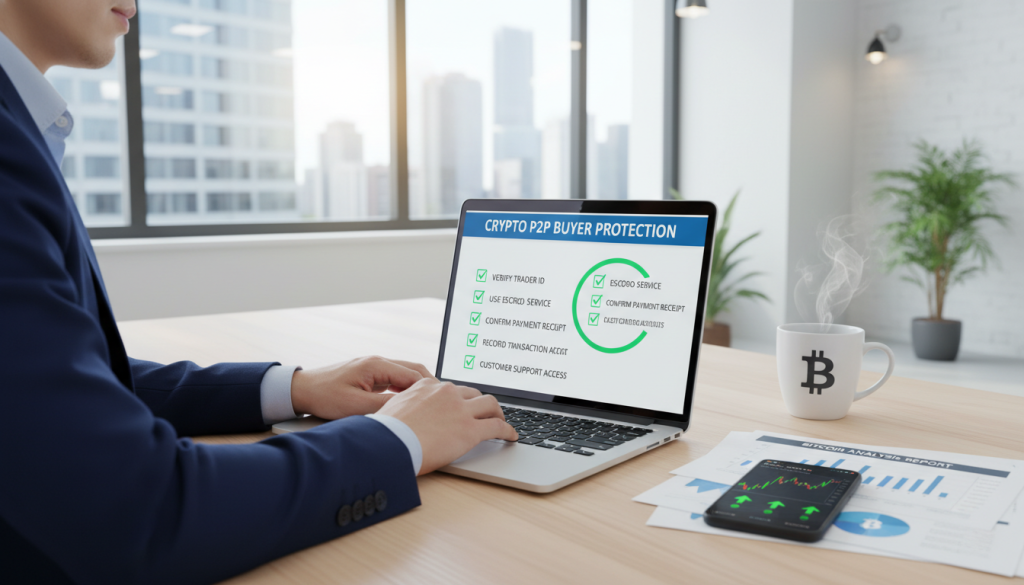
Crypto P2P Trading Buyer Protection: A Step-by-Step Safe Buying Checklist
A structured checklist helps keep purchases consistent and lowers the chance of losses.
Confirm seller credibility: check verified identity markers, read reviews beyond overall stars, and favour profiles with high completed transactions. Look for consistent trading history and repeated positive feedback.
Keep communication inside the order chat only. Platform messages are the primary evidence in disputes. Do not accept off-platform negotiation or payment directions.
Select lower-risk payment methods
Prefer methods with clear settlement times and low reversal risk. Treat reversible channels as higher risk and confirm finality before any release.
Verify funds directly
Log into your own bank account or wallet to confirm the exact amount and sender name. Never accept screenshots as proof.
Release crypto only after confirmation
Wait for platform escrow status and verified bank clearance. Do not yield to pressure or claims of delayed receipts.
Document everything
- Save receipts, timestamps, order IDs, and full chat logs.
- Capture payer names to match the counterparty’s verified identity—important for UAE transfers.
| Checklist Step | What to Verify | Why It Matters | Action |
|---|---|---|---|
| Seller credibility | Verified ID, reviews, completed trades | Reduces impersonation and repeat fraud | Prefer high-count accounts |
| Payment finality | Settlement visibility, reversibility | Prevents chargebacks | Use low-reversal methods |
| Evidence | Bank confirmations, chat logs, receipts | Speeds disputes and supports appeals | Store and timestamp files |
Common P2P Scams Targeting Buyers and How to Spot Them
Fraudsters often try to rush financial steps or move communication off the platform to avoid records.
Fake receipts and escrow-pressure tactics: a seller may show polished screenshots or claim an “escrow transaction” that only completes after you release funds. Trust only the platform escrow status and confirm the amount in your own bank account before any release.
Phishing and fake customer support: attackers imitate official pages or messaging and ask for passwords or confirmations. Real support will not request credentials. Verify links and contact support through the platform menu.
Other common tricks to watch for
- Man-in-the-middle moves: moving chat to Telegram or WhatsApp removes evidence and enables swapped payment details.
- Triangle scams: reused payment proof across multiple transactions creates mismatched payer names in disputes.
- Chargebacks, checks, and reversible payment methods: these can be contested after funds leave your bank—avoid them.
- SMS spoofing and cancellation-after-payment bait: notifications can be forged; always confirm in the bank app.
- Fake giveaways: any request to send funds to unlock a reward is a red flag.
| Scam | How it works | Red flag | What to do |
|---|---|---|---|
| Fake receipt | Forged screenshots claim payment sent | Pressure to release before settlement | Check your bank account; keep chat on-platform |
| Impersonation | Fake support asks for credentials | Unsolicited links or urgent requests | Use official support channel; never share passwords |
| MitM via messaging apps | Conversation moved off-platform to alter details | Request to continue on Telegram/WhatsApp | Refuse off-platform moves; cancel order if needed |
| Chargeback/triangle | Reused proof or reversible payments used | Mismatched payer name or repeated receipts | Prefer final payment methods; document bank transfers |
Key rule: verify in your bank account or wallet and keep all communication on the platform. That simple step prevents most scams and helps support resolve disputes swiftly.
Red Flags During a Transaction That Should Make You Pause or Walk Away
Some signals in the middle of a transaction indicate elevated risk and merit a pause.

Urgency and intimidation
Scammers compress decision time so a buyer skips verification and may release crypto prematurely.
Threats—like claims the account will be frozen or that “support” demands an immediate release—are designed to force mistakes.
Off-platform requests and unusual payment methods
Moving communication or payment off the platform is a deal-breaker. Third-party transfers or split payments make disputes harder and increase chargeback risk.
Inconsistencies and missing information
Watch for changing stories, mismatched payer names, or evasive answers about transaction IDs. Lack of verifiable information often signals intent to defraud.
Pause protocol: stop, verify the payment in your own bank or wallet, save the chat, and if uncertainty remains—walk away or escalate to support. For a deeper primer on safe marketplaces, consult this beginners guide to p2p trading.
| Red flag | Why it matters | Action |
|---|---|---|
| Urgency/intimidation | Promotes rushed release crypto decisions | Stop and verify with bank/app |
| Off-platform moves | Removes evidence and platform safeguards | Refuse and cancel trade if pressured |
| Third-party transfers | Payer names mismatch, higher chargeback risks | Insist on direct transfers from verified account |
| Inconsistent information | Signals deception or error | Ask for transaction IDs and wait for confirmation |
When Things Go Wrong: Disputes, Evidence, and Customer Support
When funds or status don’t match expectations, swift documentation and a calm appeal matter most. The platform’s escrow status is the first checkpoint; it shows whether assets remain secured while the case is reviewed.
How the appeal path typically works
Open an appeal from the order page once escrow is active. Provide bank confirmations, transfer reference numbers, and the order ID.
Platform specialists compare payment proof to on-platform messages and timestamps before deciding.
Why “Mutual Agreement” can be risky
Do not accept Mutual Agreement under pressure. It can finalize a cancellation and release assets. Instead, request mediation and upload evidence so the platform can judge facts objectively.
What evidence helps most
Strong items include bank confirmation pages, transfer reference numbers, wallet records, full chat logs, and platform timestamps. Screenshots of SMS or social messages are weaker than official bank pages.
Reporting suspicious users and involving customer support
Escalate to customer support early if you feel intimidated or see mismatched payer names. Report with order numbers, a short timeline, and labeled files so the platform can suspend repeat scammers and protect other users.
| Evidence | Example | Why it matters |
|---|---|---|
| Bank confirmation | Official transfer page with reference | Shows settlement and sender identity |
| Wallet record | Transaction hash or receipt | Proves on-chain movement |
| Chat logs | Full platform conversation | Preserves communication and timestamps |
Organize one folder per order with labeled screenshots and a short timeline that matches platform timestamps. Consistent reports improve platform security and reduce future scams for UAE users.
Conclusion
A disciplined checklist and slow decision-making cut most fraud risks in direct-market trades.
Choose a reputable platform, harden your account, keep all messages on-platform, and verify payment in your own bank before releasing assets. These steps form the core buyer logic for safe crypto trading in the UAE.
Most scams rely on urgency, off-platform moves, or forged receipts—so pause, confirm names on payments, avoid public Wi‑Fi during transfers, and save clear evidence for disputes.
Use the checklist before your next trade, start small with any new peer, and treat offers that look too good as warning signs. For details on data and privacy practices, see the site’s privacy policy.